Why garage doors jump track in San Diego's 1967-1992 tract homes: worn brackets, bent rail, mild-climate causes versus impact damage, and what's worth fixing.
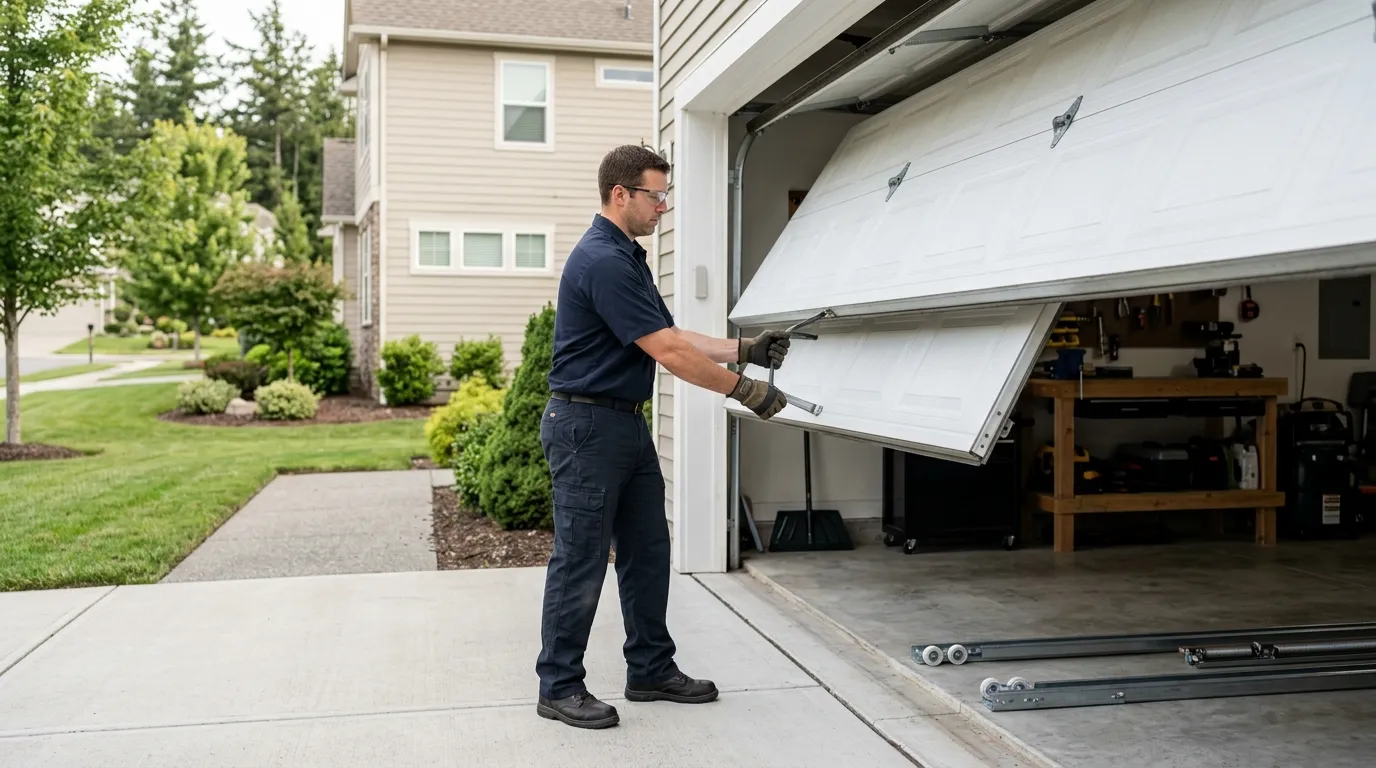
We're not going to hand you a number here, because a door off its track can mean three different jobs and three different prices. Sometimes it's one bent section of rail from a bumper tap - you straighten or swap that section and the door's back on. Sometimes a roller has worn down to the point it won't stay seated, which is a parts swap, not a structural fix. And sometimes the track itself is fine but the bracket holding it to the framing has pulled loose after decades of the door slamming against it, which means opening the wall side up to reset it properly. What drives the bill is which of those three you've got, plus whether the opener's travel limits and force settings need resetting afterward so it doesn't happen again in a month. A phone call where you tell us what you're seeing - grinding, a visible gap between roller and rail, the door catching on one side - gets you a real number fast. Guessing at a price before we've looked at the bracket and the rail alignment would be more likely to mislead you than help you.
Doing Nothing For Now
A door that's partway off track will usually still open and close, which is exactly what makes people put off the call. But a roller riding outside its rail is putting sideways load on the opener's drive system that it was never built to carry, and the cables on either side of the door are no longer sharing the door's weight evenly. Keep running it and you're more likely to end up with a snapped cable or a cracked panel than with the same minor misalignment you started with. The other cost of waiting is timing: once a bracket has pulled far enough from the framing, the fix moves from a rail adjustment to a bracket reset, which takes longer and costs more. None of that means every off-track door is an emergency - a door that's binding but still moving slowly under its own power can usually wait a day or two for a scheduled visit rather than an after-hours one. But leaving it running while it's visibly off the rail is the one choice that reliably turns a small job into a bigger one.
What the Weather Here Does to It
San Diego sits in a mild temperate band, and that actually works in a homeowner's favor here compared to a lot of the country. The aluminum and steel track on a garage door expands and contracts with temperature, and in cities with hard freezes and hot summers that constant cycling is what loosens track brackets and warps rail over time. That's mostly not what's happening in this climate. When a door here jumps track, weather is rarely the direct cause - you're looking at a physical hit to the door, a roller that's simply worn out, or hardware that's been in place since the house was built and has finally loosened on its own. That's worth knowing because it changes where you look for the problem: instead of checking for frost heave or a track that's warped from summer heat, the more useful question is when the door and its hardware were last touched. If nobody's serviced the track and rollers since the house was built, age and use are doing the work that weather does in other places.
The Situation
Most of the housing in the areas we work - Serra Mesa, Kearny Mesa, Clairemont Mesa, Linda Vista, Tierrasanta, and the rest of the neighborhoods within a few miles - went up between 1967 and 1992, with a lot of it dating to the 1960s and 70s. A door installed when one of those houses was built is now pushing fifty years old, and track brackets from that era were often fastened straight into the stud framing without the reinforcement plates that are standard on new installs. Across the roughly 48,883 owner-occupied houses in this service area, a good share are still running that original hardware, which is a big part of why off-track calls cluster in these older sections rather than in newer construction. With a median household income of $118,431 across the area, most owners here can afford to replace a door outright once the track and hardware are this far past their working life, and depending on what we find, that's sometimes the more honest recommendation than patching original brackets that are just going to keep loosening.
How it works
From “it’s stuck” to “it’s fixed”
1
Tell us what’s wrong
Describe the symptom - won’t open, loud bang, opener runs but the door won’t move.
2
On-site diagnosis
A technician tests the door under power and by hand and finds what actually failed.
3
Clear, up-front plan
You get the fix that’s needed and what drives the cost - before any work starts.
4
Repaired & tested
The repair is done, the door is set true and tested, and the work area left clean.
Serving San Diego, CA - tell us what your door’s doing and we’ll take it from there.
Why did my garage door suddenly come off the track with no warning?
Usually there was warning, it just wasn't loud yet - a roller grinding faintly, the door hesitating an inch before it caught. Something finally gave, often a worn roller or a bracket that had been loosening for years. On homes built in the 1960s-70s wave common across this area, original hardware reaching the end of its life is the most common cause.
Can I push the door back onto the track myself?
You can sometimes reseat a roller by hand if the door is fully down and the spring isn't under tension, but we'd rather you didn't. A door on cables and torsion springs stores real force, and a bracket that looks fine can pull loose the moment you put weight on it. This is one job worth the call.
Does San Diego's weather cause this kind of thing?
Not directly, no. The mild temperate climate here means the track isn't cycling through the freeze-thaw swings that crack brackets in colder regions. When a door jumps track in this area it's almost always age, impact, or worn hardware rather than weather.
Is it worth fixing an old track system or just replacing the door?
Depends on what else is worn. If the rollers, cables, and opener are all original to a house from the 1970s-80s, patching just the bracket often means you're back out again within a year or two for the next worn part. We'll tell you honestly which side of that line your door is on.
Ready to get your garage door sorted?
Tell us what it’s doing and where you are in San Diego - we’ll take it from there.